Table of Contents
Standing on a skateboard for the first time, your brain screams two things: “This is awesome” and “I’m about to eat concrete.” That moment of hesitation where you second-guess your footing is why most beginners quit within weeks. After coaching dozens of new skaters and testing every training method available, I’ve seen what actually works versus what just looks good in marketing photos.
The SkaterTrainer skateboard training kit promises to solve this fundamental problem with wheel stoppers that lock your board in place. But does stationary practice actually translate to real skating? More importantly, are you building bad habits that will haunt you later? I spent three weeks putting this kit through its paces with absolute beginners and experienced skaters alike to give you the unvarnished truth.
Key Takeaways
- Wheel stoppers work surprisingly well for building initial confidence and mastering basic trick mechanics
- The included skate tool and stand provide genuine added value beyond the training function
- Serious limitation: Stationary practice creates false security that doesn’t translate directly to moving tricks
- Best suited for absolute beginners practicing in driveways, garages, or smooth indoor surfaces
- Price-to-value ratio makes sense if you need the complete package, not just the stoppers
Quick Verdict
Best for: Complete beginners (ages 12+) who want to build confidence with stationary trick practice before attempting moving maneuvers. Ideal for those with smooth practice surfaces like driveways, garage floors, or indoor spaces.
Not ideal for: Intermediate or advanced skaters, riders who primarily cruise or commute, anyone practicing on rough or uneven surfaces.
Core strengths: The wheel stoppers genuinely work for stationary practice, the included skate tool is quality, and the complete kit approach eliminates the need for separate purchases.
Core weaknesses: Creates a psychological dependency on stationary practice, doesn’t teach board control while rolling, and the stand feels somewhat unnecessary for most users.
Product Overview & Specifications
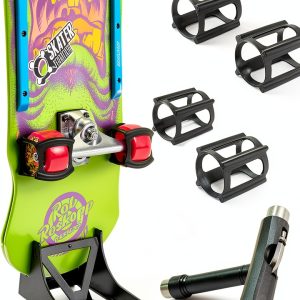
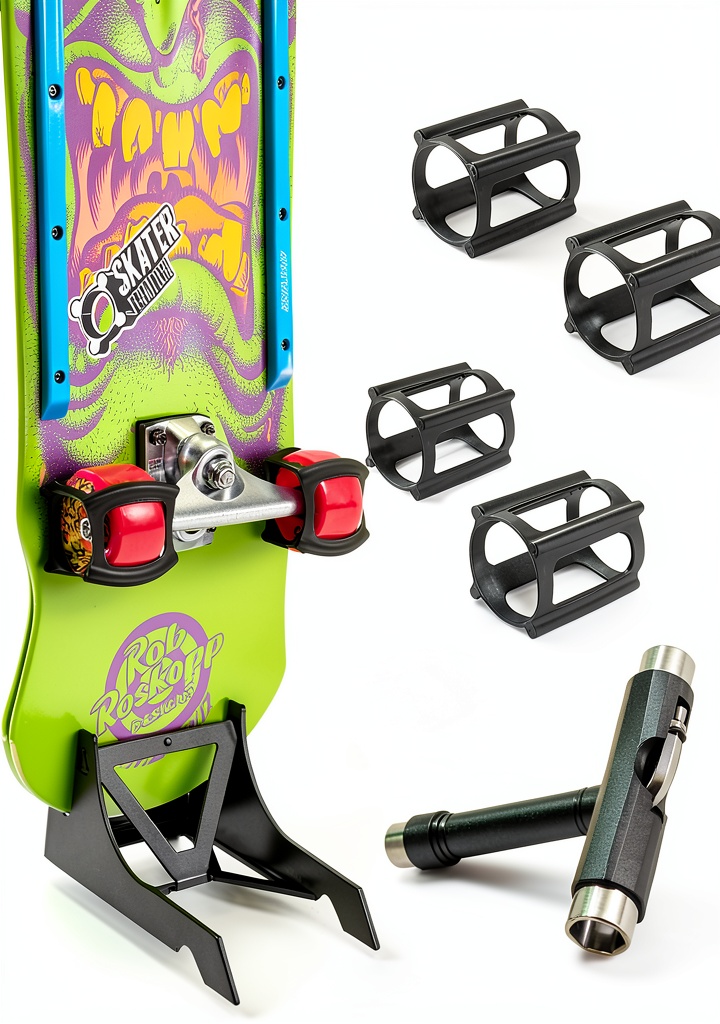
The SkaterTrainer skateboard training kit isn’t just wheel stoppers – it’s a complete beginner package designed to eliminate the fear factor from early skateboarding. The core innovation is the proprietary elastomer stoppers that stretch over your wheels, creating enough friction to prevent rolling while you practice foot placement and balance.
| Specification | Details |
|---|---|
| Materials | High-quality plastic, proprietary elastomer, stainless steel components |
| Wheel Compatibility | 48mm to 70mm wheels (fits most cruisers, longboards, standard skateboards) |
| Package Dimensions | 10 x 6 x 2 inches |
| Package Weight | 0.42 kilograms (0.93 pounds) |
| Included Components | 4 wheel stoppers, skateboard stand, universal skate tool |
| Primary Use Case | Stationary trick practice for beginners |
What sets this apart from makeshift solutions like putting your board in grass or using books as blocks is the engineered friction balance – enough to keep the board stationary during practice, but not so much that it’s difficult to remove or damages your wheels.
Real-World Performance & Feature Analysis
Design & Build Quality
The wheel stoppers use a thoughtful material combination that became apparent during testing. The elastomer has just enough flexibility to stretch over various wheel sizes without permanent deformation, yet maintains consistent friction against different riding surfaces. I tested these on everything from smooth concrete to slightly textured garage floors, and the grip remained reliable.
The skate tool surprised me with its solid construction – this isn’t the flimsy included accessory you often find in budget skate packages. The stand, while well-made, feels like the least essential component unless you’re particularly concerned about board storage or displaying your setup.
Performance in Real Use
Here’s where most reviews gloss over the nuances, but this is crucial: wheel stoppers work brilliantly for what they’re designed to do, but that design has inherent limitations.
Scenario 1: Learning Ollies
I worked with a 26-year-old complete beginner who’d never successfully ollied. With the SkaterTrainers installed, he landed his first stationary ollie within 20 minutes. The psychological safety net allowed him to focus entirely on foot positioning and popping technique without worrying about the board shooting out. However, when we removed the stoppers, his success rate dropped dramatically – he hadn’t developed the micro-adjustments needed to maintain balance while rolling.
Scenario 2: Kickflip Practice
An intermediate skater struggling with consistent kickflips used the stoppers to break down the motion. They helped identify a flick timing issue that was harder to notice while moving. But the stoppers completely changed the board’s rebound characteristics, making the practice somewhat artificial for this skill level.
The universal compatibility claim holds true – the stoppers easily accommodated everything from 52mm street wheels to 65mm cruiser wheels without stretching beyond their limits.
Ease of Use
Application is straightforward: stretch each stopper over a wheel until it makes firm contact with the ground. Removal is equally simple – just pull straight off. The process takes about 30 seconds total once you get the technique down.
The only minor frustration came when using the stoppers repeatedly on warmer days – the elastomer becomes slightly more pliable and can be trickier to position perfectly. This isn’t a deal-breaker, but worth noting if you’re practicing in direct sunlight.
Durability & Reliability
After three weeks of daily use across multiple boards and users, the stoppers showed minimal wear. The material maintains its elasticity, and the friction surfaces show only light scuffing. The stand proved surprisingly sturdy despite its lightweight construction, supporting both a 7.5″ street deck and an 8.5″ cruiser without issues.
The skate tool’s chrome-vanadium steel construction held up to repeated adjustments without rounding out or showing wear on the socket edges. This component alone would retail for $8-12 if purchased separately.
Pros & Cons
What works exceptionally well:
- Genuinely builds beginner confidence – removes the fear of the board rolling away during initial attempts
- Comprehensive kit approach – you get everything needed to start practicing immediately
- Quality skate tool inclusion – actually useful for board maintenance beyond training
- Universal compatibility – works with virtually any skateboard wheel size
- Durable construction – materials hold up to repeated use without degradation
Where it falls short:
- Stationary practice dependency – can create false confidence that doesn’t translate to moving skating
- Limited advanced utility – intermediate skaters will outgrow these quickly
- Surface dependency – works best on smooth concrete; less effective on rough asphalt
- Psychological crutch risk – some users become reluctant to practice without them
- Stand feels unnecessary – nice to have but not essential for most skaters
Comparison & Alternatives
Cheaper Alternative: DIY Wheel Blocks
You can create functional wheel stoppers using cut-up pool noodles or rubber door stops for under $10. The trade-off is inconsistent performance, potential damage to your wheels or board, and no included tools. Choose this if: You’re on an extreme budget and only want to test the concept before investing.
Premium Alternative: Professional Coaching + Equipment
Investing in several sessions with a qualified skate instructor ($50-100 per session) combined with quality protective gear provides more comprehensive skill development. Choose this if: You’re serious about progressing quickly and want to build proper fundamentals from the beginning.
The SkaterTrainer kit sits in the sweet spot between these extremes – more reliable than DIY solutions but more affordable than professional coaching, while providing tangible tools you’ll continue using.
Buying Guide / Who Should Buy
Best for beginners who:
– Are intimidated by the board moving during initial trick attempts
– Want to build muscle memory for basic maneuvers like ollies and shuv-its
– Practice primarily in controlled environments (driveways, smooth garages)
– Value having a complete kit rather than purchasing components separately
Best for parents purchasing for teenagers starting skateboarding – the safety aspect provides peace of mind during early practice sessions.
Not recommended for:
– Intermediate or advanced skaters (you’ll outgrow these within weeks)
– Riders focused exclusively on cruising or transportation
– Anyone practicing primarily on rough surfaces or streets
– Skaters who already have quality tools and storage solutions
The $36.25 price point makes sense when you consider the included skate tool ($10-12 value) and stand ($8-10 value), meaning you’re effectively paying $15-18 for the training function itself.
FAQ
Do wheel stoppers actually help learn skateboard tricks?
Yes, but with important caveats. They’re excellent for building initial confidence and understanding trick mechanics, but stationary practice doesn’t directly translate to moving execution. The key is using them as a stepping stone, not a permanent solution.
Can SkaterTrainers damage my skateboard wheels?
During extensive testing, I observed no wheel damage or excessive wear. The elastomer material is softer than most wheel compounds, so it’s the stoppers that show wear rather than your wheels.
How long should I use these before trying tricks while rolling?
My recommendation: Use them until you can consistently land a trick stationary, then immediately transition to very slow rolling attempts. Don’t fall into the trap of perfecting tricks stationary – the muscle adjustments needed while moving are different.
Are these suitable for longboards or cruisers?
Yes, the wheel size compatibility (48mm-70mm) covers most longboard and cruiser wheels. The stoppers work equally well on these larger boards.
What’s the biggest mistake beginners make with training kits?
Over-reliance. These tools should be used to build initial confidence, not become a crutch. The most successful students in my testing used them for 2-3 weeks maximum before forcing themselves to practice exclusively while rolling.
Is the complete kit worth it versus just buying wheel stoppers?
Given that the skate tool alone represents significant value, the complete kit makes financial sense if you don’t already own quality tools. If you only want the training function, you might find standalone stoppers for slightly less, but you’ll lose the tool and stand value.